


e-ISSN: 3116-3238
Aims and Scope
The DDOSC Multidisciplinary Research Journal is the official peer-reviewed publication of Davao de Oro State College, dedicated to disseminating high-quality research in the fields of education, criminology, agriculture, entrepreneurship, and other related disciplines.
The journal welcomes research and development reports from any field of study, with preference given to works that address or contribute to improving the socio-economic conditions of the province and its neighboring regions.
We accept the following types of manuscripts:
- Original Research Reports – Results of original studies that have not been published nor simultaneously submitted elsewhere, except as abstracts for oral or poster presentations.
- Review Articles – Syntheses of existing literature in areas where information is scattered, or reviews that offer new interpretations and stimulate further research.
Publication Frequency
The DDOSC Multidisciplinary Research Journal is published biannually every May and December.
About the Publisher
Davao de Oro State College (DDOSC) is a public higher education institution committed to providing quality instruction, research, and community engagement in the Province of Davao de Oro, Philippines. As an emerging state college, DDOSC aims to nurture competent graduates, advance relevant and responsive research, and promote sustainable development within the province and its neighboring regions.
Davao de Oro State College – Main Campus serves as the official publisher of the DDOSC Multidisciplinary Research Journal (DDOSCMRJ), reflecting its commitment to disseminating scholarly work that addresses pressing issues, enriches academic discourse, and supports evidence-based decision-making in the community.
Contact Details: rdd.publication@ddosc.edu.ph
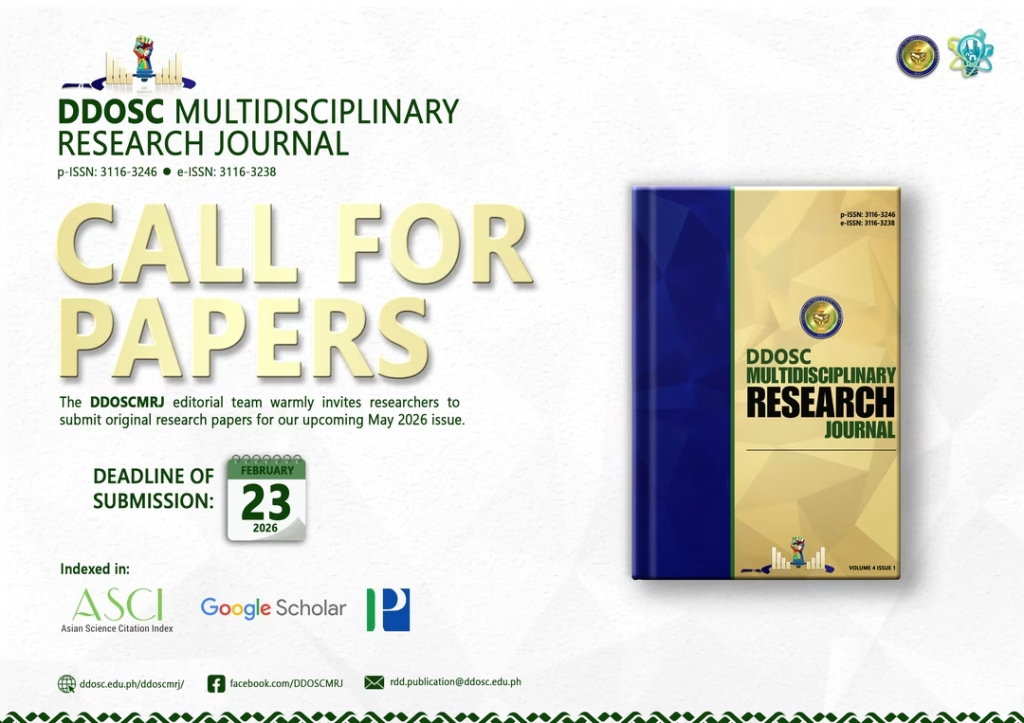
Issue Title
Click the cover to view full PDF/Flipbook

Enhancing Students’ Mastery of Integer Operations Through a Collaborative Learning Strategy Using KenKen Puzzles
Kyla M. Hinampas, Gemar B. Magbutong

Exploring Monosemy in Political Editorial Articles from a Student Publication Through Critical Discourse Analysis
Christian Mel L. Almerez, Ken Rhyl L. Pagad, and Jasmine Rose Fiel-Geverola

Unpacking Students’ Perspective on Youtube as a Language Learning Tool in Developing Phonetic Skills: A Phenomenological Study
Claro A. Galo, Jr., Jenna Mae S. Urbano, and Eric D. Palmerola

The Role of Language Learning Apps and Software in Developing English Language Proficiency Among Bachelor in Elementary Education Students: A Sequential Explanatory Study
Grace L. Calolo, Shennie V. Puerin, and Nancy J. Gemarino
Designing and Validating a Parental Involvement Scale for STEM Students in Learning Science: Insights from Exploratory Factor Analysis
Trisha Nicole M. Alcaraz, Leah Mae S. Sarifa, and Rubylyn C. Cagampang
General Author Guidelines
All manuscripts must be written in clear, grammatically correct English. Authors whose native language is not English are strongly encouraged to have their manuscripts professionally edited before submission.
- Submissions must be original, unpublished, and not under consideration for publication elsewhere. Manuscripts must also be free from plagiarism.
- The journal accepts research articles and review papers that contribute to the advancement of knowledge in relevant fields.
- Manuscripts should be between 5,000 and 7,000 words.
- A minimum of 20 references is required, of which (a) at least 80% must be primary sources (e.g., peer-reviewed journal articles), (b) references should predominantly be from the last 10 years, unless considered seminal works, and (c) preference is given to references from reputable international journals and authors.
- All submitted manuscripts undergo a double-blind peer review process. Only those meeting the journal’s quality and ethical standards will be considered for publication in the DDOSC Multidisciplinary Research Journal.
- Manuscripts must strictly follow the journal’s prescribed format and style guidelines.
Manuscript Preparation Guidelines
Structure of the manuscripts
Title. The manuscript should begin with a title that is concise, clear, and informative, not exceeding twelve (12) words. It must reflect the central issues or themes discussed in the article and should avoid uncommon abbreviations.
- Author’s names and institutions. The author information must include the names of the authors without academic degrees or job titles. Each name should be accompanied by the institutional affiliation and email address.
- Abstract. An abstract written in English must follow. It should consist of one paragraph with a length of 150–250 words and contain the background and rationale, objectives, methods (design, participants or sample, instruments, and analysis), key results, conclusions, and the contributions of the study. At the end of the abstract, three to five keywords or phrases should be provided.
Introduction. The introduction must logically present the general background and rationale of the study and a review of related literature. It should highlight how the present work differs from earlier studies and, in its final section, state the research purpose or questions as well as the novelty of the study. The introduction should not exceed three (3) pages.
Method. The method section should clearly describe the research design, the population and sample or participants, the instruments and materials used, the procedures followed in conducting the research, and the techniques employed in both data collection and data analysis.
Result and Discussion. The results and discussion should present the findings supported by appropriate data, such as tables, figures, or statistical analyses. These results must directly address the research objectives or hypotheses outlined in the introduction. The discussion must explain how the findings relate to the research questions (what/how), provide scientific interpretations (why), compare results with those of other investigators (what else), and account for similarities, differences, and implications. This section should also highlight the contribution of the study to theory, practice, or policy.
Conclusion. The conclusion should summarize the main findings and how they answer the research objectives, while also emphasizing their significance and contributions. It should not simply repeat the abstract or results but instead highlight the implications, provide recommendations, and suggest directions for future research.
References. The references should include only sources cited in the manuscript. At least 20 references are required, with 80% drawn from primary sources such as peer-reviewed journal articles. Most references should be from international authors and reputable sources published within the last 10 years, unless citing seminal works. Authors are encouraged to use reference management software such as EndNote, Mendeley, or Zotero. All references must conform to the American Psychological Association (APA) 7th edition citation style.
Peer Review Guidelines
The DDOSC Multidisciplinary Research Journal (DDOSCMRJ) follows a double-blind peer review system to maintain fairness, anonymity, and objective assessment of all submitted manuscripts.
- Every submission undergoes an initial editorial screening (desk review), where the editor evaluates its relevance to the journal’s scope, quality standards, and overall readiness for peer review.
- The editorial team aims to provide the corresponding author with a review decision within 15 to 30 working days. However, manuscripts requiring more extensive evaluation may take additional time.
- Authors will receive the editorial decision along with constructive comments and recommendations from the referees.
If revisions are required, authors must submit a revised manuscript that adequately addresses all referee concerns. The revised version will be reassessed by the original reviewers or, when necessary, by the editorial board.
The final publication decision is determined by the referees’ evaluations and the judgment of the editorial board.
- All manuscripts are handled with strict confidentiality, and the identities of reviewers remain undisclosed to ensure a fully anonymous and unbiased review process.
Open Access Policy and Article Processing Charge
- The DDOSC Multidisciplinary Research Journal (DDOSCMRJ)is fully open access, allowing readers free and unrestricted access to all published articles.
- The journal is funded entirely by the Davao de Oro State College. Authors are not charged any article processing fees (APCs).
Publication Ethics
Authors must ensure that their manuscripts are original, properly cited, and prepared in accordance with accepted academic and ethical standards.
- Authorship should be granted only to individuals who have made substantial contributions to the study. All listed authors must approve the final manuscript and agree to its submission.
- Authors are required to disclose any potential conflicts of interest, whether financial or personal, that may influence the research or its interpretation.
- Research involving human participants or animals must comply with established ethical guidelines. Authors may be asked to submit documentation of ethical clearance or informed consent when applicable.