
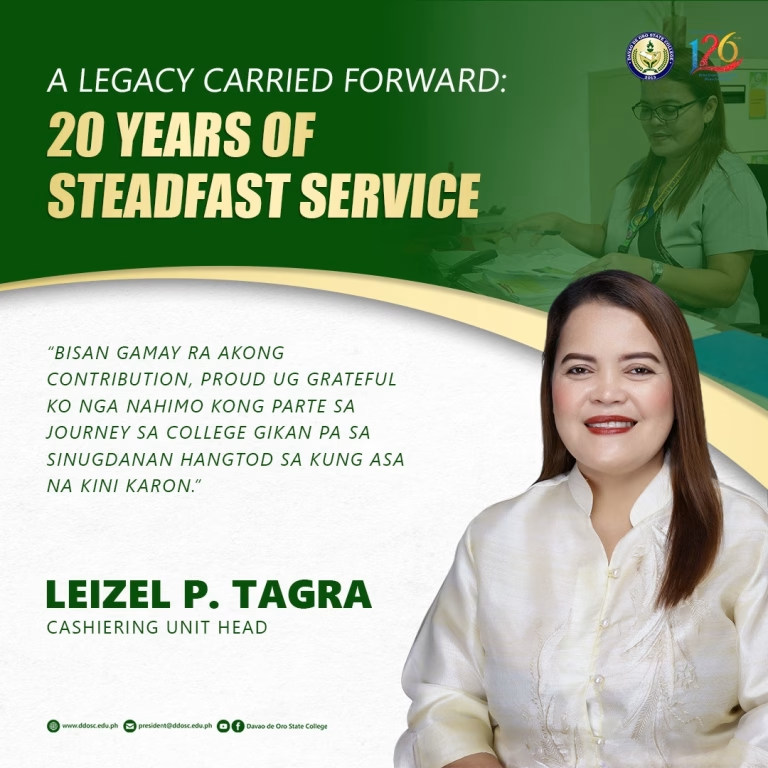
A Legacy Carried Forward: 20 Years of Steadfast Service
As a child, she watched neighbors come to their home with requests for help. Her grandfather, then a Barangay Captain, was often the person they turned to.
For young Leizel, those ordinary moments quietly planted a lasting lesson: service is not measured by what one receives, but by what one is willing to give.
“Sa gamay pa ko nga bata, nasaksihan nako ang akong Lolo nga nagsilbi isip Barangay Captain. Kada adlaw, adunay mga tawo nga moadto sa among balay aron mangayo og tabang, ug bisan gamay ra ang honorarium niadtong panahona, gipili gihapon niya ang pagserbisyo.”
(When I was still a little girl, I witnessed my grandfather serving as a Barangay Captain. Every day, people would come to our house asking for help, and even though the honorarium at the time was small, he still chose to serve.)
As fate would have it, Leizel P. Tagra would eventually follow a similar path. Now Head of the Davao de Oro State College Cashiering Unit, she has spent two decades in government service.
Through the years, that childhood memory has remained at the heart of why she continues to serve.
Following in her grandfather’s footsteps
To supplement her income, Leizel also worked part-time as an Accounting Clerk for the University of Southeastern Philippines–External Studies Program in Compostela. At the time, the decision was largely practical. She simply wanted to earn more and make ends meet.
What she did not yet know was that this part-time job would open the door to an institution that would eventually become a defining part of her professional life.
The external studies program would later evolve into what is now Davao de Oro State College. And Leizel, who had entered its halls simply looking for additional work, would eventually become an important pillar of the institution.
Growing with the College
Her connection with the institution, then known as Compostela Valley State College, deepened as the school itself began to take shape.
During CVSC’s formative years, Leizel was among the employees who helped carry the demands of a growing institution. Her work in accounting and budget-related functions gave her a close view of the College’s early operations and gradually strengthened her expertise in financial administration, accountability, and institutional processes.
“Usa ko sa mga nakasaksi kung giunsa pagsugod ang College, sa panahon nga daghan pa ang nagduhaduha ug nibabag sa pag-establish niini. Nasaksihan pud nako ang mga sakripisyo ug mga luha sa mga nangulo nga naningkamot nga matukod ang Compostela Valley State College.”
(I was among those who witnessed how the College began, at a time when many still doubted and opposed its establishment. I also witnessed the sacrifices and tears of the leaders who worked to establish Compostela Valley State College.)
In June 2015, she joined the College as a permanent Administrative Officer II. Six years later, in August 2021, she was hired as Administrative Officer V, a position she holds with pride and integrity.
The weight of trust
With her promotion came another colossal responsibility: leading the Cashiering Unit.
To some, cashiering may seem like a mundane, even boring, facet of government operations—receiving payments, issuing receipts, maintaining records, and assisting clients through transactions.
For Leizel, however, years of working closely with financial processes had taught her to see the work differently.
Public money demands public trust.
“Dako kaayo nako og appreciation ang pagsalig nga gihatag sa akoa, especially because we are handling public funds. Mao nga kinahanglan gyud nga careful, honest, and accountable sa among trabaho.”
(I deeply appreciate the trust given to me, especially because we are handling public funds. That is why we have to be careful, honest, and accountable in our work.)
That trust, she learned, extends far beyond processing employees’ salaries or completing bank transactions. It requires discipline, sound judgment, and the willingness to remain accountable even when doing so is difficult.
As her responsibilities grew, so did the weight of the decisions she had to make. Over the years, public service taught her that doing the job well is only one part of being a civil servant. At certain times, the true test comes when the easier choice contradicts the right one.
At one point in her career, Leizel found herself facing exactly that kind of dilemma: loyalty on one side, and her responsibility as a public servant on the other.
It became one of the most difficult periods of her two decades in government service.
In the end, she chose duty.
“I overcame it by choosing to remain professional and uphold my integrity. I learned that in public service, our duty and commitment to what is right should always come first.”
It is a lesson forged not from textbooks or seminars, but from the realities of staying long enough in public service to discover that integrity matters most. Oftentimes, preserving it comes at a great cost.
The price behind the scenes
Twenty years can be compressed neatly into employment dates and position titles in one’s Personal Data Sheet.
However, what the four-page PDS document cannot show are the missed hours with family.
The urgent deadlines.
The work that extends beyond office hours.
The pressure of knowing that a mistake can affect not only oneself, but an office, an institution, or the people relying on a government service.
“Sa public service, daghan og sacrifices nga dili makita sa mga tawo. Usahay, kinahanglan i-prioritize ang trabaho kaysa personal nga panahon alang sa pamilya, labi na kung naay deadlines, urgent nga buluhaton, o kinahanglan nga motabang sa mga tawo bisan beyond office hours.”
(In public service, there are many sacrifices that people do not see. Sometimes, work has to take priority over personal time with family, especially when there are deadlines, urgent tasks, or people who need assistance even beyond office hours.)
Yet amid those unseen sacrifices are equally quiet rewards.
Some come in the form of a simple thank you.
Among the memories she treasures most are encounters with students and stakeholders she once assisted who later returned with stories of having finished their education, found jobs, and built better lives.
“Labi na kanang makadawat ka og personal nga pasalamat gikan sa mga tawo nga imong natabangan—especially students nga natabangan nimo nga makahuman og eskwela ug karon naa na sa nindot nga trabaho. Makaproud ug fulfilling kaayo nga makita sila nga successful na sa ilang kinabuhi.”
(It is especially meaningful when you personally receive thanks from people you have helped, particularly students whom you assisted in finishing school and who now have good jobs. It makes me proud and fulfilled to see them succeed in life.)
Perhaps this is why, after two decades in government, she measures service less by position or years rendered.
For Leizel, its truest measure lies in the people reached and the quiet knowledge that her work mattered to someone.
20 years later
Two decades can change nearly everything.
The young woman who once returned home to Compostela now juggles different responsibilities: College Cashier, a wife, and a proud mother of two.
The external studies program where she once worked part-time grew into a thriving State College.
She, too, grew with it.
Along the way, DdOSC taught her patience, flexibility, responsibility, teamwork, and the value of understanding people from different circumstances.
Yet through all those changes, one principle remained constant.
It was the same one she first learned from her grandfather:
Service. Principled service.
“Hangtod karon, akong gihuptan ang prinsipyo nga akong nakat-onan sa akong Lolo—ang pagtabang ug pagserbisyo sa mga kasilinganan kutob sa akong mahimo.”
(Until now, I continue to hold on to the principle I learned from my grandfather—to help and serve others however I can.)
This September, as the country celebrates the Philippine Civil Service Anniversary, Leizel’s two decades in government offer a reminder that public service is built not only through positions earned or years rendered.
A civil servant’s work is often defined by the things few people see. It lies in the sacrifices that remain unseen and in the unmistakable will to remain faithful to one’s duty even when the efforts seem unnoticed.
For Leizel, those 20 years have unfolded alongside the growth of an institution she once knew in its infancy. She witnessed its uncertainties, carried responsibilities through its formative years, and eventually found a permanent place in the College she had helped take off to the skies.
Looking back, she speaks of that journey with her signature humility.
“Bisan gamay ra akong contribution, proud ug grateful ko nga nahimo kong parte sa journey sa College—gikan pa sa sinugdanan hangtod sa kung asa na kini karon.”
(Even if my contribution was small, I am proud and grateful to have become part of the College’s journey—from its beginnings to where it is today.)
Perhaps that is where the meaning of her 20 years rests.
The little girl who once watched her grandfather serve eventually found her own calling. What she inherited as an example, she carried forward as a life of service.
Twenty years on, the legacy lives on.
This special feature for the celebration of the Philippine Civil Service Anniversary is part of the #BulawanongSugilanon series, which highlights the stories of DdOSCians that truly deserve to be told. Stay tuned for more inspiring narratives from the DdOSC community.